


Uterine Fibroids Treatment:
A Complete Guide to All Options
Uterine fibroids are noncancerous growths that develop in or on the uterus. They are very common during the reproductive years, but experts have not been able to pinpoint the exact underlying cause. Some people never notice them. Others deal with heavy periods, pain, or pressure that affects their daily life.
Make An AppointmentWhat is the best uterine fibroid treatment?
The best treatment for your fibroids may depend on your symptoms, age, plans for pregnancy, and how large or numerous your fibroids are. Some women who do not have symptoms or only have mild symptoms may do fine just monitoring their fibroids and watching for any changes, but others may need treatment to alleviate symptoms that are affecting their quality of life.
This guide will provide an overview of common treatments for fibroids so you will understand the options available, what each one involves, and when it may be used.
Uterine Fibroids Overview
Fibroids are made of the same type of muscle and fibrous tissue as the muscular layer within the uterus. They can grow inside the uterus, on the outside surface, or within the uterine walls.
Fibroid Facts
- Fibroids are also called leiomyomas and myomas.
- They are almost always benign.
- They can be tiny, like a grain of rice, or as large as a pumpkin.
- A woman may have one fibroid or several.
- Fibroid symptoms are normally determined by the side and location of the fibroids.
- Some women are more prone to developing fibroids than others:
- African American women are 3 times more likely to develop fibroids.
- Those who started their periods at a young age.
- Women who suffer from obesity
- Women who have a family history of fibroids.
- Women who eat a diet high in red meat.
- Women with a vitamin D deficiency.

Common fibroid symptoms include:
- Heavy period bleeding
- Menstrual periods that last longer than normal
- Pelvic pressure or pain
- Frequent urination
- Constipation
- Pain during sex
- Back or leg pain
- Anemia
- Issues with fertility
Fibroids are often discovered during a routine pelvic exam or imaging test because they do not always cause symptoms.
The American College of Obstetricians and Gynecologists reports that treatment is not always necessary if the fibroid symptoms are mild or there are no symptoms.

When Is Fibroid Treatment Needed?
Treatment may be needed for women who are experiencing symptoms that significantly disrupt their normal schedule at home or at work, and reduce their quality of life
The type of treatment you may need can depend on the ways your life is affected and how severe your symptoms are.
What do doctors consider when choosing a treatment?
- Your age.
- Your current health.
- The number of fibroids you have.
- How the fibroids are affecting your ability to handle your normal daily routine.
- If the fibroids are affecting your health.
- The size and location of the fibroids.
- Whether you desire children in the future.
There is no single “best treatment for fibroids” that works for everyone.
What Are The Uterine Fibroids Treatment Options?
Watchful waiting
When women are only experiencing mild symptoms, or they do not have any symptoms, their doctor may choose to only monitor their fibroids and watch for any changes. Watchful waiting may be recommended when:
- There are no symptoms, or they are mild.
- Fibroids are small
- You are close to menopause because fibroids often shrink as your estrogen levels drop.
- If you are pregnant, this is usually the only option, and doctors will closely monitor you throughout your pregnancy to ensure the fibroids are not causing complications.
Monitoring normally involves regular pelvic exams, imaging, and symptom tracking.
Medications
Medications do not remove or directly treat fibroids, but they can help manage some of the symptoms. They are often used as the first step in uterine fibroid treatment before a procedure or surgery. Some of the different medications used include:
Hormonal Birth Control
Birth control pills, patches, or IUDs can help regulate periods and reduce bleeding by helping to balance your hormones. They may help:
- Make your periods lighter.
- Reduce the severity and frequency of cramping.
- Help keep the timing of your cycle more normal.
Gonadotropin-Releasing Hormone (GnRH) Agonists
These medications lower your estrogen level and sometimes can shrink fibroids.
- They are only recommended for very short-term use due to side effects.
- When discontinued, fibroids begin to grow again.
- They may be used before surgery to make fibroids smaller.
GnRH Antagonists
Newer medications that work like GnRH agonists but may have fewer or milder side effects than older medications. They can help reduce symptoms like heavy bleeding by lowering your hormone level in a more controlled way. To help alleviate severe symptoms, they are often combined with “add back” therapy, which involves giving small amounts of hormones back to your body while you are on the medication.
Tranexamic Acid
This is a medication that is taken during your period to help reduce heavy menstrual bleeding without using hormones.
Pain Relievers
Medications that you can purchase over-the-counter, like ibuprofen, may help reduce some cramping and discomfort.
According to the Mayo Clinic, medications might help reduce your symptoms, but they do not eliminate fibroids, so they may not be effective if you have large fibroids and severe symptoms.
Non-Surgical Procedures For Fibroid Symptoms
If medications are not effective enough, there are some minimally invasive procedures that may treat your symptoms without major surgery.
High-Intensity Focused Ultrasound (HIFU)
HIFU uses ultrasound waves that are carefully targeted to heat and destroy fibroid tissue without incisions. Studies show that high-intensity focused ultrasound (HIFU) may reduce fibroid size and improve symptoms for some women.
How it works:
- The doctor uses MRI or ultrasound to guide the treatment process.
- Targeted fibroids are heated without damaging the surrounding tissue.
- Your body gradually absorbs the treated tissue.
Benefits include:
- There are no incisions.
- The recovery time is short.
- Reduced risk of complications vs. surgery.
Limitations:
- Does not work on all fibroid types or large fibroids.
- Availability may be limited because it is only performed by a select number of interventional radiologists.
- Long-term results are still being tracked.
Endometrial Ablation
Endometrial ablation is a procedure that destroys or removes the lining of the uterus to reduce heavy bleeding.
How it works:
There are several different techniques used to destroy the inner lining of the uterus, but most do not directly treat the fibroids. Some examples include
- Radiofrequency ablation
Uses heat energy delivered through a device inside the uterus and is very commonly used. Can sometimes shrink fibroids.
- Thermal balloon ablation
A balloon filled with heated fluid is placed in the uterus, and the heat destroys the lining.
- Cryoablation (freezing)
The uterine lining is frozen and destroyed. (used less often today)
- Microwave ablation
Uses microwave energy to heat and destroy the lining.
- Hydrothermal ablation
Uses heated fluid that circulates inside the uterus
- Electrosurgical ablation (hysteroscopy)
Uses electrical energy to remove or destroy the lining.
Benefits include:
- May significantly reduce heavy menstrual bleeding
- Quick procedure with minimal hospital time in many cases
- No large incisions since it is minimally invasive
- Shorter recovery compared to major surgery
- The uterus is preserved
Limitations:
- It does not usually remove fibroids or change their size.
- It is not recommended for women who desire children.
- Ablation may not completely stop the symptoms of bleeding for everyone.
- It is not normally as effective for larger fibroids or women with certain uterine shapes.
- Sometimes, symptoms can gradually return.
Non-Surgical Procedure That Treats The Actual Fibroids
Uterine Fibroid Embolization (UFE)
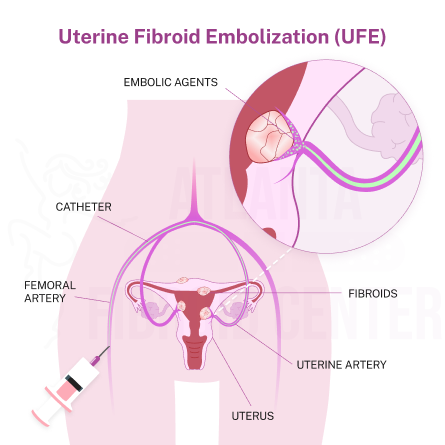
Uterine fibroid embolization is also called uterine artery embolization, and the procedure blocks blood flow to fibroids, causing them to shrink. It is performed by a specially trained interventional radiologist like those at the Atlanta Fibroid Center.
How it works:
- A catheter is inserted into a targeted blood vessel.
- Tiny particles are injected to block the fibroids’ blood supply.
- Fibroids gradually shrink and die.
Benefits include:
- The procedure is minimally invasive and preserves the uterus without surgery.
- The procedure is 90% effective and is usually considered permanent.
- It can treat different-sized fibroids and any that are attached to any location within the uterine artery.
Studies show successful pregnancies and healthy births after UFE, but fertility and pregnancy results are still being researched.
Surgical Fibroids Treatment Options
In some cases, your OB/GYN may recommend surgery to eliminate the symptoms of fibroids. Non-surgical UFE is not usually offered by an OB/GYN because this procedure requires an expertly trained interventional radiologist.
Myomectomy
Myomectomy surgery removes fibroids one at a time while leaving the uterus in place.
Types include:
- Hysteroscopic myomectomy for fibroids inside the uterus
- Laparoscopic myomectomy using small incisions
- Open surgery for larger or multiple fibroids
Benefits:
- Can remove some fibroids
- Preserves the uterus
- May improve fertility potential
Limitations:
- The doctor may not be able to reach all fibroids.
- Fibroids can come back.
- May weaken the uterus and require a C-section during a future pregnancy.
- Recovery time depends on the type of surgery.
- Risk of scar tissue that can affect conception potential.
Hysterectomy
Hysterectomy surgery removes the entire uterus and fully eliminates fibroids, but also causes sterilization and removes the possibility of future pregnancy.
Benefits
- It is a permanent solution.
- No risk of fibroid recurrence.
Limitations:
- It is a major surgery with a substantial recovery
- Risks are higher
- Ends the ability to become pregnant
Mayo Clinic research reports that the loss of your uterus may be linked to other serious health conditions.

Uterine Fibroid Embolization
Band-Aid Only
Total Incision Length: <1 Inches

Conventional Laparoscopic Surgery
(3-4) 5mm Ports
Total Incision Length: 2 Inches

Robotic Laparoscopic Surgery
(2) 12mm Ports (3) 8mm Ports
Total Incision Length: 2-3 Inches

Open Surgery
Single Long Incision, Horizontally Or Vertically
Total Incision Length: 12 Inches
How To Choose The Best Treatment For Fibroids
Choosing the right treatment for uterine fibroids can be overwhelming, so it is best to work with a doctor with expertise in treating fibroids.
Dr. John Lipman with the Atlanta Fibroid Center can help determine if you are a candidate for the less invasive UFE procedure. Many women wish to avoid surgery and preserve their fertility, but are never informed of all their treatment options.
To learn more about uterine fibroid embolization, set up a consultation today.
Frequently Asked Questions
Yes. Sometimes new fibroids can grow or existing ones can become larger. The possibility of them recurring depends on the type of treatment used.
- Medications do not remove fibroids and only treat the symptoms.
- Myomectomy can remove some existing fibroids but may not be able to fully remove them all depending on their location. Existing ones can grow larger, or new ones may form.
- UFE shrinks fibroids and normally prevents them from becoming larger again.
- Hysterectomy prevents recurrence because the uterus is removed.
Research shows that fibroids may come back in about 20% to 60% of patients after a myomectomy within five years and report lower recurrence rates, of between 15% and 30%, after uterine fibroid embolization.
Fibroids are almost always noncancerous, and the risk of a fibroid becoming cancer (leiomyosarcoma) is very rare. If a fibroid grows quickly or causes unusual symptoms, your doctor may recommend further evaluation to rule out other conditions.
How fast fibroids grow can be different for each person. Some fibroids stay the same size for years, and others can grow much faster.
Experts know that fibroids respond to estrogen, which can cause them to quickly become larger. During pregnancy, fibroids often grow due to the significant increase in estrogen that typically occurs over the first several months. During menopause they often shrink down as your body stops producing as much estrogen.
Yes. Some lifestyle habits can help keep fibroids and their symptoms under better control. Some of the things you can do to help reduce some of the symptoms of fibroids include:
- Maintaining a healthy weight.
- Eating a balanced diet rich in fruits and vegetables.
- Managing your stress levels.
- Following a fibroid diet that includes green tea.
- Make sure you are getting enough vitamin D.
- Avoiding eating an excessive amount of red meats.
- Read labels and avoid products that expose you to excess estrogen.
- Check in with your doctor regularly.
These may help reduce fibroid-related symptoms but will not eliminate your fibroids.
You should talk with your doctor if you notice:
- Heavy bleeding that interferes with your daily routine.
- You have severe pelvic pain.
- You experience sudden changes in your menstrual cycle.
- You have had unexplained difficulty getting pregnant.
- You have abdominal or pelvic pressure or pain that continues to get worse.
Finding out the underlying cause of your symptoms early can help you understand your options and avoid future complications.

